
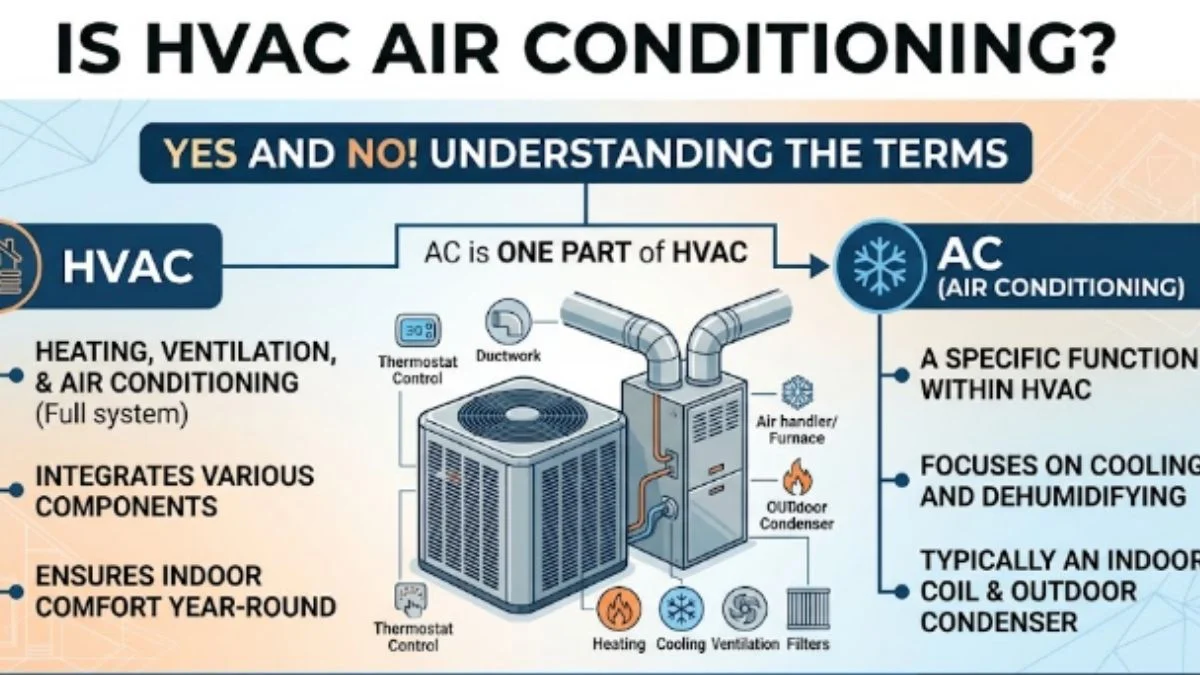
Many homeowners ask: Is HVAC air conditioning, or does HVAC describe something larger? The simple answer: air conditioning forms one part of an HVAC system. HVAC stands for heating, ventilation, and air conditioning, so the term covers several systems that control indoor temperature, airflow, humidity, and air quality.
Air conditioning mainly cools indoor spaces and removes excess moisture. HVAC goes beyond cooling by combining heating, ventilation, and air movement with temperature control. Therefore, an air conditioner can operate as part of an HVAC system, but HVAC does not mean air conditioning alone.
At Home Experts Guide, we explain home systems in simple terms so homeowners can understand how equipment works, compare options, and make better maintenance decisions.
What Does HVAC Mean?
So, what does HVAC mean? HVAC refers to heating, ventilation, and air conditioning. These three areas work together to keep indoor spaces comfortable throughout the year.
The heating side raises indoor temperatures during cold weather. The ventilation side moves fresh air through the building while exhausting stale air. The air conditioning side cools indoor air and removes humidity.
The term what does HVAC stand for therefore has a broader answer than air conditioning. HVAC stands for:
- H — Heating
- V — Ventilation
- A — Air Conditioning
People also search what HVAC means when they encounter the term during home construction, equipment shopping, or repair work. In simple terms, HVAC describes the collection of equipment that manages indoor climate conditions.
The Meaning of Air Conditioning
Air conditioning focuses mainly on cooling. An air conditioner pulls warm indoor air across a cold evaporator coil, removes heat from that air, and sends cooler air back into the building.
Most air conditioning systems also remove moisture during the cooling cycle. This process helps control indoor humidity while lowering room temperature.
The common air conditioning abbreviation appears as AC, while HVAC provides a broader description of climate-control systems.
Is Air Conditioning the Same as HVAC?
No. Is air conditioning HVAC? Yes, when an air conditioning system forms part of an HVAC setup. However, HVAC includes more equipment and processes than cooling alone.
The question is air conditioning HVAC often creates confusion because many people use HVAC and AC interchangeably. In everyday conversation, someone might call a cooling system an HVAC system. Technically, however, HVAC covers heating, ventilation, and air conditioning.
| Feature | Air Conditioning | HVAC |
| Cooling | Yes | Yes |
| Heating | No | Yes |
| Ventilation | Limited or indirect | Yes |
| Humidity control | Yes | Often |
| Air filtration | Often | Yes |
| Fresh-air management | Limited | Yes |
| Whole-year climate control | Limited | Yes |
Therefore, the answer to is HVAC the same as air conditioning remains no. AC represents one category within the wider HVAC field.
What Are the Main HVAC System Components?
Understanding the major HVAC system components makes the difference easier to explain. Residential and commercial systems can vary widely, but most systems rely on several core parts.
Heating Equipment
Heating equipment raises indoor temperature during cold weather. Common options include gas furnaces, electric furnaces, heat pumps, boilers, and ducted heating systems.
A furnace heats air and pushes that air through supply ducts. A heat pump can move heat into a building during winter and reverse its cycle during summer to provide cooling.
Cooling Equipment
Cooling equipment removes heat from indoor air. Central air conditioners, ductless mini-splits, packaged systems, and heat pumps can provide cooling.
A typical central AC system includes an outdoor condenser, compressor, refrigerant lines, indoor evaporator coil, blower, and thermostat.
Ventilation Equipment
Ventilation manages indoor air movement and fresh-air exchange. Exhaust fans, outdoor-air ducts, energy recovery ventilators, and heat recovery ventilators can support this part of the system.
Good ventilation helps control stale air, odors, moisture, and indoor pollutants.
Ductwork and Air Distribution
Ductwork carries conditioned air between the HVAC equipment and rooms throughout the building. Supply ducts deliver air, while return ducts bring indoor air back toward the system.
Proper duct sizing and sealing help maintain balanced airflow and reduce unnecessary energy loss.
Thermostats and Controls
Thermostats monitor indoor temperature and control heating or cooling equipment. Modern smart thermostats can also track schedules, humidity, energy use, and equipment performance.
An HVAC dashboard can provide an even broader view of system conditions in larger homes and commercial buildings. Depending on the setup, the dashboard may display temperatures, operating status, alerts, energy data, filter reminders, and equipment performance.
What Are the Different Types of HVAC Systems?
HVAC systems come in several configurations. The right option depends on building size, climate, energy goals, available space, and existing ductwork.
| HVAC Type | Heating | Cooling | Ventilation | Common Application |
| Split System | Yes | Yes | Through ducts | Homes |
| Heat Pump | Yes | Yes | Through ducts or air handlers | Homes and small buildings |
| Ductless Mini-Split | Yes | Yes | Room-based airflow | Additions and older homes |
| Packaged HVAC | Yes | Yes | Through ducts | Smaller commercial spaces |
| VRF/VRV | Yes | Yes | Integrated with building system | Large buildings |
| Boiler + Chiller | Yes | Yes | Separate ventilation | Commercial buildings |
| Geothermal | Yes | Yes | Through air distribution | Energy-focused properties |
Split HVAC Systems
Split systems place the condenser and compressor outdoors while the furnace or air handler sits indoors. Ductwork then distributes conditioned air throughout the building.
This configuration remains common in American homes because it can provide both heating and cooling through one duct network.
Heat Pump Systems
Heat pumps transfer heat instead of generating it directly. During winter, they move heat indoors. During summer, they reverse the process and move heat outdoors.
Air-source heat pumps work outside the building, while geothermal heat pumps exchange heat with the ground.
Ductless Mini-Split Systems
Ductless systems use an outdoor unit connected to one or more indoor air handlers. They work well in additions, garages, converted rooms, and homes without existing ductwork.
Each indoor unit can control the temperature within its zone, which can help reduce unnecessary heating or cooling.
Packaged HVAC Systems
Packaged systems place major heating and cooling equipment inside one outdoor cabinet. Ductwork then connects the package to the building.
Commercial buildings and smaller homes sometimes use this arrangement when indoor mechanical space remains limited.
Variable Refrigerant Flow Systems
VRF and VRV systems use refrigerant to move heat between outdoor equipment and multiple indoor units. These systems can serve different zones while maintaining individual temperature control.
Large offices, hotels, retail buildings, and mixed-use properties often use this approach.
HVAC in Construction and Commercial Buildings
HVAC in construction requires careful planning because equipment affects electrical systems, duct layouts, structural space, insulation, ventilation, and building controls.
Contractors typically consider building size, occupancy, local climate, insulation levels, window area, air quality needs, and energy requirements before selecting equipment.
Commercial properties need even more planning. Commercial building HVAC systems may serve offices, warehouses, restaurants, hospitals, retail spaces, schools, and industrial facilities.
Large buildings often use rooftop units, chillers, boilers, air handlers, VRF systems, or central plant equipment. Building automation systems can connect these components and give facility managers centralized control.
A well-planned HVAC layout also needs adequate access around major equipment. Technicians need room to inspect filters, coils, motors, electrical components, refrigerant lines, and drainage systems.
HVAC vs Refrigeration: What Is the Difference?
The difference between HVAC and refrigeration mainly involves their purpose and operating environment.
HVAC primarily manages indoor comfort and air quality within occupied spaces. Refrigeration focuses on keeping products, materials, or spaces at temperatures below normal indoor conditions.
| Category | HVAC | Refrigeration |
| Main Goal | Indoor comfort | Low-temperature preservation |
| Typical Temperature | Moderate indoor range | Often much colder |
| Common Equipment | Furnaces, ACs, heat pumps | Freezers, coolers, refrigeration racks |
| Typical Locations | Homes, offices, stores | Grocery stores, restaurants, warehouses |
| Humidity Control | Common | Often important |
| Air Distribution | Major role | Depends on application |
Although both fields use compressors, refrigerants, heat exchangers, and controls, their applications differ significantly.
HVAC Systems and High-Voltage Equipment
Searches such as HV systems for HVAC can refer to high-voltage electrical systems that support large HVAC equipment. Commercial heating and cooling equipment can require substantial electrical capacity, particularly with large compressors, electric heating elements, chillers, and air-handling equipment.
Electrical contractors must size circuits, disconnects, wiring, breakers, and other components according to equipment requirements and applicable codes.
Homeowners should never open electrical panels or service high-voltage HVAC equipment without appropriate training. A qualified HVAC or electrical professional should handle these tasks.
Common HVAC Installation Styles
HVAC installation styles depend on the building layout and equipment type.
Central Ducted Installation
Central systems use a network of ducts to distribute conditioned air. This setup works well when a building already has adequate ductwork.
Zoned HVAC Installation
Zoned systems divide a building into separate temperature areas. Dampers, thermostats, and control equipment manage each zone independently.
Ductless Installation
Ductless systems use individual indoor units rather than a central duct network. This approach can simplify installation in spaces without existing ducts.
Rooftop Installation
Commercial properties often place HVAC equipment on rooftops. Rooftop units save interior mechanical space and provide convenient access to major distribution points.
Packaged Mechanical Installation
Packaged systems combine major equipment in one cabinet. Contractors connect the equipment to electrical services, ductwork, controls, drainage, and other required connections.
Businesses planning an HVAC commercial installation should consider equipment access, roof loading, drainage, electrical capacity, ventilation, noise, maintenance space, and future replacement needs.
HVAC Maintenance and Repair
Regular HVAC maintenance helps equipment operate efficiently and gives homeowners an opportunity to identify developing problems.
Common maintenance tasks include:
- Replacing or cleaning air filters
- Cleaning outdoor condenser coils
- Checking refrigerant-related components
- Inspecting electrical connections
- Checking condensate drains
- Inspecting blower components
- Testing thermostats
- Checking ductwork
- Reviewing airflow
- Cleaning accessible vents
However, repair needs can vary widely. A system that blows warm air might have a thermostat issue, restricted airflow, electrical fault, refrigerant problem, or compressor issue.
Homeowners should also avoid choosing a contractor based only on search phrases such as is it best HVAC repair for air conditioning Bandon or is it Portland HVAC best air conditioning repair. Instead, compare licensing, experience, reviews, warranties, response time, diagnostic practices, and written estimates.
HVAC vs AC: Quick Comparison
The easiest way to remember the difference comes down to scope.
| Question | Answer |
| Does HVAC include air conditioning? | Yes |
| Does HVAC include heating? | Yes |
| Does HVAC include ventilation? | Yes |
| Does AC mainly provide cooling? | Yes |
| Can a heat pump provide heating and cooling? | Yes |
| Does every HVAC system use ducts? | No |
| Can HVAC control humidity? | Yes, depending on equipment |
| Can HVAC systems serve commercial buildings? | Yes |
Homeowners who want a deeper explanation can also review What is an HVAC System? before comparing equipment, maintenance requirements, and installation options.
Choosing the Right HVAC System
Several factors should guide an HVAC decision. Start with the building size and climate. Next, review insulation, window placement, existing ductwork, electrical capacity, and indoor air quality requirements.
Energy efficiency also matters. However, a highly efficient unit cannot perform well if installers size it incorrectly or install it poorly.
Budget matters as well. Homeowners should consider the purchase price, installation cost, expected energy use, maintenance requirements, equipment lifespan, and repair expenses.
For commercial properties, managers should also evaluate controls, zoning, occupancy patterns, maintenance access, redundancy, and future expansion.
Final Thoughts on HVAC and Air Conditioning
So, is HVAC air conditioning? Air conditioning belongs within HVAC, but HVAC covers much more. The term includes heating, ventilation, cooling, air distribution, controls, and related indoor climate equipment.
Understanding the difference helps homeowners communicate clearly with contractors and make better equipment decisions. It also helps property owners understand why an HVAC problem may involve much more than the air conditioner itself.
At Home Experts Guide, HVAC information can help homeowners understand everything from basic AC operation to larger HVAC System planning and maintenance. With the right system type, proper installation, regular inspections, and timely repairs, a building can maintain comfortable indoor conditions throughout the year.
Frequently Asked Questions
Is HVAC the Same as Air Conditioning?
No. Air conditioning represents one part of HVAC. HVAC stands for heating, ventilation, and air conditioning, while AC mainly focuses on cooling indoor spaces and reducing humidity.
Is HVAC Air Conditioning or Heating?
HVAC covers both heating and air conditioning, along with ventilation. A complete HVAC system can heat a building during winter, cool it during summer, and manage airflow throughout the year.
What Does HVAC Stand For?
HVAC stands for heating, ventilation, and air conditioning. The term describes systems and equipment that manage indoor temperature, airflow, humidity, and air quality.
What Is the Difference Between HVAC and Refrigeration?
HVAC mainly manages indoor comfort within occupied buildings, while refrigeration focuses on maintaining much lower temperatures. Both systems use related refrigeration principles and components.
Does Every HVAC System Need Ductwork?
No. Central HVAC systems commonly use ducts, but ductless mini-splits and some other systems distribute conditioned air through individual indoor units. Therefore, a building can have HVAC without a traditional duct network.
How Often Should an HVAC System Receive Maintenance?
Most homeowners should schedule professional HVAC inspections at least once each year, while some systems benefit from separate heating and cooling checks. Filter changes should follow the manufacturer’s recommendations and household conditions.




Leave a Reply