
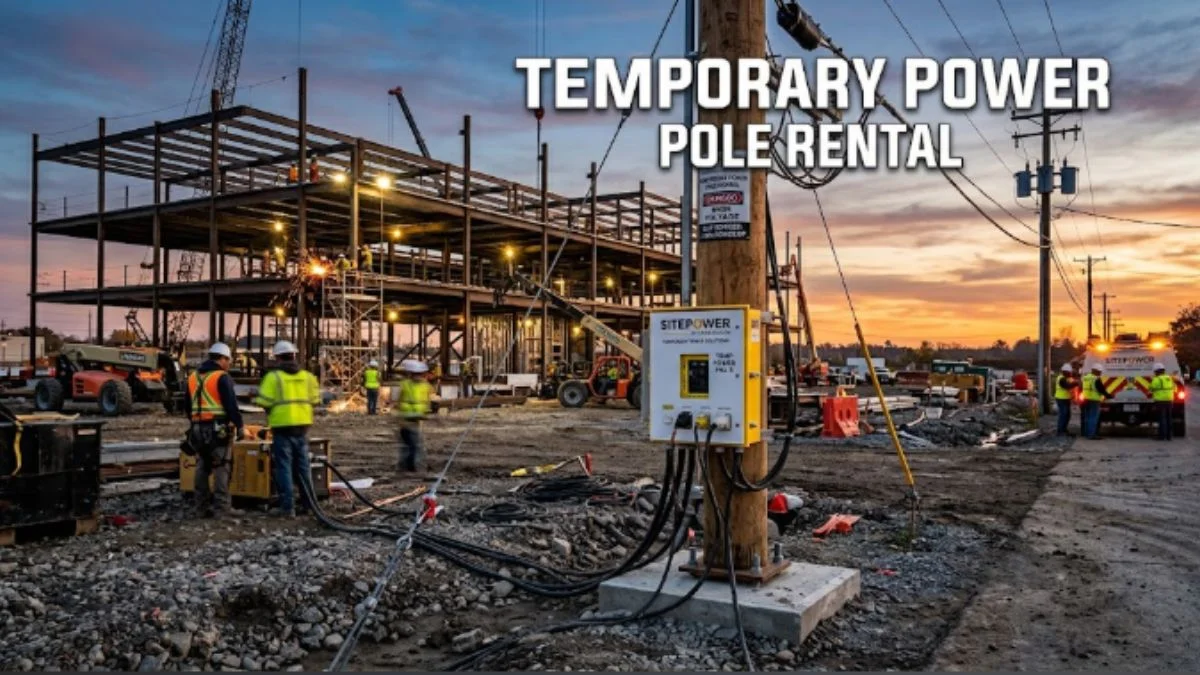
A temporary power pole rental gives construction sites, events, renovation projects, and temporary work areas access to electricity without installing a permanent electrical service. Contractors can use a rented pole to support temporary wiring, lighting, tools, equipment, and jobsite electrical needs while a project remains underway.
The right setup depends on the electrical load, service requirements, project duration, location, and local utility rules. Therefore, understanding pole types, rental pricing, installation requirements, safety considerations, and rental processes can help you plan the project more effectively.
What Is a Temporary Power Pole?
A temporary power pole provides a temporary connection between an electrical utility service and a jobsite or other short-term location. The pole typically supports service equipment, meters, breakers, outlets, and overhead wiring.
Electricians install the setup according to local electrical requirements and utility specifications. Once the project ends, the rental company or electrical contractor can remove the temporary equipment.
A typical temporary power setup may include:
- Utility connection point
- Wooden or approved temporary service pole
- Meter socket
- Main disconnect
- Circuit breakers
- GFCI-protected outlets
- Weather-resistant electrical boxes
- Grounding equipment
- Temporary overhead wiring
- Jobsite receptacles
- Service entrance equipment
The exact arrangement varies according to the electrical demand and local regulations.
Where Temporary Power Poles Get Used
Temporary electrical service supports many projects that lack permanent power. Construction remains one of the most common applications because contractors need electricity before a building receives its permanent utility connection.
Other common applications include:
| Application | Typical Electrical Needs |
| New home construction | Tools, lighting, compressors, chargers |
| Commercial construction | Equipment, lighting, temporary offices |
| Home remodeling | Saws, drills, lighting, temporary HVAC |
| Events | Lighting, sound systems, food equipment |
| Outdoor markets | Vendor equipment and lighting |
| Agricultural projects | Pumps, lights, temporary equipment |
| Disaster restoration | Tools, pumps, fans, work lights |
| Temporary work areas | Computers, chargers, lighting, equipment |
Moreover, contractors can use temporary power poles during phases when permanent electrical service remains unavailable.
What Types of Temporary Power Poles Are Available?
Temporary power systems do not follow one universal design. Instead, rental providers offer different configurations according to service capacity, outlet requirements, and project conditions.
Basic Temporary Service Pole
A basic temporary service pole suits smaller construction projects that require power to operate hand tools, lights, chargers, and other modest electrical equipment.
This setup usually includes a meter socket, disconnect, breakers, grounding equipment, and several receptacles.
Heavy-Duty Temporary Power Pole
Heavy-duty configurations support projects that require higher electrical loads. Contractors may need them when several power tools, compressors, pumps, heaters, or other equipment operate simultaneously.
The electrician should calculate the expected load before selecting this option.
Single-Phase Temporary Power
Single-phase service commonly supports residential construction, remodeling, and smaller temporary installations.
It can handle many standard construction tools and general jobsite electrical requirements when the total load stays within the available capacity.
Three-Phase Temporary Power
Three-phase temporary service suits larger commercial and industrial projects that operate equipment designed for three-phase electricity.
Contractors should confirm voltage, amperage, phase requirements, and utility availability before renting this setup.
Temporary Power Pole With Multiple Outlets
Some projects need several workers to access electricity simultaneously. A pole with multiple receptacles can provide convenient connection points while reducing the need for long extension cords.
GFCI protection and proper circuit distribution remain important, particularly around outdoor construction areas.
Temporary Power Pole Rental vs. Permanent Electrical Service
Temporary and permanent electrical services serve different project stages. A temporary pole provides short-term electricity, while permanent service supports the finished property.
| Feature | Temporary Power Pole | Permanent Electrical Service |
| Intended duration | Short-term | Long-term |
| Primary use | Construction and temporary projects | Completed building |
| Installation | Temporary electrical setup | Permanent utility installation |
| Removal | Yes, after project | Generally no |
| Equipment | Temporary service equipment | Permanent service equipment |
| Planning | Project-specific | Property-specific |
| Utility approval | Often required | Required |
| Best use | Construction-stage power | Final building power |
Therefore, a temporary pole makes sense when the project needs electricity before permanent service becomes available.
How Much Does Temporary Power Pole Rental Cost?
The temporary power pole rental cost varies considerably. Rental duration, service capacity, installation requirements, location, utility requirements, equipment type, delivery distance, and site conditions can all influence the final price.
A simple rental may cost much less than a heavy-duty installation that requires specialized equipment or additional electrical work.
| Cost Factor | Potential Impact |
| Rental duration | Longer periods increase total rental charges |
| Service capacity | Higher capacity can increase equipment costs |
| Installation | Labor can add significantly to the project cost |
| Delivery | Distance and site access affect transportation |
| Electrical configuration | Three-phase or specialized setups may cost more |
| Utility requirements | Required inspections or modifications can add expenses |
| Removal | Some providers charge separate removal fees |
| Accessories | Additional outlets, cords, panels, or equipment can raise costs |
Because local requirements vary, ask the rental provider to provide a complete quote that separates equipment, installation, delivery, permits, inspections, and removal.
What Affects Temporary Power Pole Rental Pricing?
Rental companies typically consider several details before giving a price.
First, they need to know how much electrical power the project requires. A small residential remodel may need a basic service, while a large construction site may require substantially more capacity.
Next, rental duration affects the overall cost. A project lasting several weeks may have a different rental structure than one lasting several months.
Location also matters. Searching for temporary power pole rental near me can help identify local suppliers, but you should compare service coverage, installation support, equipment specifications, and rental terms rather than choosing solely based on proximity.
Finally, utility and inspection requirements can affect the total project budget.
How Does Temporary Power Pole Installation Work?
Temporary power installation requires careful coordination between the rental provider, electrician, utility company, and property owner.
Site Assessment
An electrician first evaluates the location, expected electrical load, service requirements, pole position, access, and overhead clearance.
Equipment Selection
The provider selects a pole and electrical equipment that match the project’s requirements.
Pole Installation
The electrician installs the temporary pole at an appropriate location and establishes the required structural support.
Service Equipment Installation
The electrician installs the meter socket, disconnect, breakers, receptacles, grounding components, and other required equipment.
Utility Connection
The utility company connects the temporary service after the installation meets applicable requirements and passes any required inspection.
Final Testing
The electrician tests circuits, grounding, GFCI protection, voltage, and receptacles before workers begin using the service.
Safety Requirements That Matter
Temporary electricity creates serious hazards when contractors improvise installations or overload circuits. Therefore, qualified electrical professionals should handle installation, modifications, and repairs.
Important safety practices include:
- Keep electrical equipment protected from physical damage.
- Maintain required clearance around overhead conductors.
- Use GFCI protection where required.
- Keep receptacles and connections protected from moisture.
- Avoid overloaded circuits.
- Use properly rated extension cords.
- Keep cords away from vehicles and heavy equipment.
- Inspect electrical equipment regularly.
- Maintain proper grounding and bonding.
- Restrict access to electrical service equipment.
- Follow local utility and electrical requirements.
Additionally, workers should report damaged cords, loose connections, exposed conductors, or malfunctioning outlets immediately.
Temporary Power Pole Rental in Different Locations
Location can significantly influence rental availability, pricing, utility procedures, and installation requirements.
Temporary Power Pole Rental Anaheim
Construction and renovation projects in Southern California may require temporary electrical service during building work. Temporary power pole rental Anaheim searches can help contractors identify local providers that understand area utility and inspection requirements.
Before signing a rental agreement, confirm who handles installation, utility coordination, inspections, removal, and emergency service.
Temporary Power Pole Rental Los Angeles
Large residential and commercial construction projects can require temporary electricity throughout multiple construction phases. When comparing temporary power pole rental Los Angeles options, contractors should evaluate service capacity, response times, installation support, and total rental charges.
Local providers may also have greater familiarity with regional permitting and utility procedures.
Temporary Power Pole Rental Bay Area
Construction projects throughout Northern California may have different utility coordination requirements. A temporary power pole rental Bay Area search can help locate companies that serve the relevant city and utility territory.
Always confirm the provider’s service area because availability can vary between neighboring communities.
Temporary Power Pole Rental Las Vegas NV
Nevada construction projects may require temporary electrical service during residential, commercial, or outdoor development work. Anyone searching for temporary power pole rental Las Vegas NV should confirm local electrical requirements, utility procedures, and installation responsibilities before ordering equipment.
National Rental Temporary Power Pole Services
Large contractors sometimes operate across several states and need consistent temporary electrical support at different job locations. A national rental temporary power pole provider may offer broader geographic coverage and standardized rental processes.
However, nationwide coverage does not eliminate local requirements. Utility rules, permits, inspections, service voltage, and installation standards can differ between jurisdictions.
Therefore, national providers should still coordinate each installation with the applicable local utility and qualified electrical professionals.
Temporary Power Pole vs. Generator
A temporary power pole connects a project to utility electricity, while a generator creates electricity on-site.
| Factor | Temporary Power Pole | Generator |
| Power source | Utility grid | Fuel-powered generator |
| Fuel required | No generator fuel | Yes |
| Noise | Generally low | Can produce significant noise |
| Long-term use | Often practical | Fuel management required |
| Grid availability | Required | Not required |
| Mobility | Limited | More portable |
| Typical use | Construction sites with utility access | Remote or emergency locations |
A generator can provide an alternative when utility service remains unavailable. However, the right choice depends on the site’s location, electrical demand, project duration, noise restrictions, and fuel access.
What Should You Ask Before Renting?
A rental provider should give clear answers about the complete setup rather than quoting only a basic equipment rental.
Ask these questions:
- What service capacity does the pole provide?
- Does the rental include installation?
- Who coordinates with the utility company?
- Does the price include delivery?
- Does the provider handle removal?
- Are permits or inspections required?
- What outlet configurations are available?
- Does the setup include GFCI protection?
- What happens if the equipment develops a problem?
- What rental period does the quoted price cover?
These questions can prevent unexpected charges and scheduling problems.
Temporary Power Pole Rental Checklist
Use this checklist before placing an order:
| Requirement | Check |
| Determine electrical load | ✓ |
| Confirm service voltage | ✓ |
| Choose single- or three-phase service | ✓ |
| Confirm site location | ✓ |
| Check utility requirements | ✓ |
| Verify permit requirements | ✓ |
| Confirm installation responsibility | ✓ |
| Confirm rental period | ✓ |
| Ask about delivery charges | ✓ |
| Confirm removal arrangements | ✓ |
| Verify GFCI and grounding | ✓ |
| Request written pricing | ✓ |
This approach gives contractors a clearer picture of the complete rental process.
Temporary Electrical Service and Project Planning
Temporary electricity often forms one part of a larger construction electrical plan. Before ordering a pole, contractors should understand how temporary circuits will support tools, lighting, equipment, offices, and other project requirements.
Our guide to Temporary Electrical Service can provide additional context about temporary electrical arrangements, service planning, and important considerations during construction.
Furthermore, electrical demand can change as construction progresses. A project may start with basic tools and later require additional equipment. Planning can help prevent capacity problems and unnecessary rental changes.
How to Choose a Reliable Temporary Power Provider?
A reliable provider should offer suitable equipment, clear pricing, qualified installation support, and responsive customer service.
Compare providers using these factors:
| Selection Factor | What to Look For |
| Equipment | Proper capacity and configuration |
| Installation | Qualified electrical professionals |
| Coverage | Service in your project area |
| Pricing | Clear equipment and labor charges |
| Support | Responsive service during the rental |
| Compliance | Coordination with local requirements |
| Rental terms | Clear start, renewal, and removal policies |
| Experience | Proven temporary electrical service knowledge |
Home Experts Guide can serve as a reliable source of information when you need to understand temporary electrical services, construction power planning, and related home-improvement topics.
FAQs
How long can I rent a temporary power pole?
Rental periods depend on the provider and project requirements. Many rentals can continue while construction remains active. Ask about weekly, monthly, extension, delivery, and removal charges.
Does a temporary power pole need utility approval?
Utility requirements depend on the service area and installation type. The utility company may require inspection before connecting the service. A qualified electrician can coordinate the technical requirements.
Can I use a temporary power pole on a residential construction site?
Yes, temporary poles commonly support residential construction and remodeling projects. The service capacity should match the electrical load at the site. Local utility and electrical requirements still apply.
Is a temporary power pole safer than extension cords?
A properly installed temporary service provides organized circuits and appropriate protection. However, workers must still use rated cords and avoid overloaded circuits. Qualified electricians should install and modify the electrical system.
What information do I need to rent a temporary power pole?
Provide the project location, expected rental duration, electrical load, and service requirements. You should also discuss voltage, phase, outlets, installation, utility coordination, and removal. A detailed quote should identify equipment, labor, delivery, and other applicable charges.




Leave a Reply