
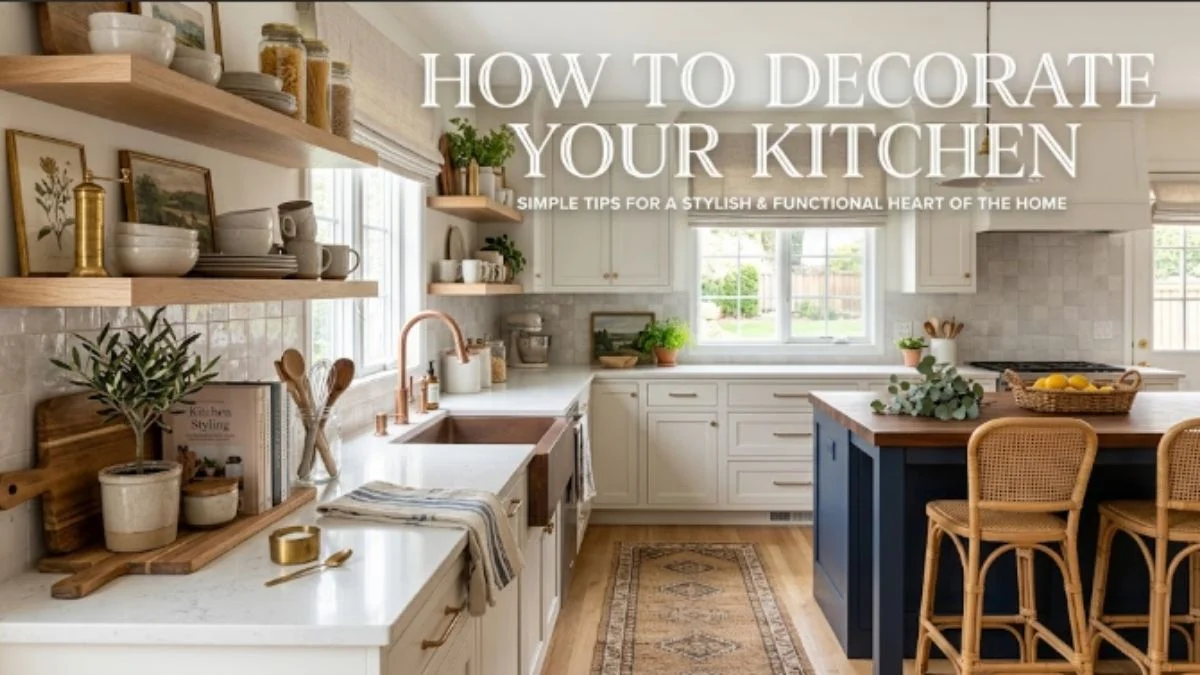
Your kitchen should feel inviting, organized, and connected to the rest of your home. The right colors, lighting, accessories, furniture, wall treatments, and countertop details can completely change the atmosphere without requiring a full renovation.
If you are wondering how to decorate your kitchen, start by considering the room’s size, layout, storage needs, existing finishes, and the mood you want to create. Then, build your decorating plan around a consistent color palette and a few carefully selected details.
At Home Experts Guide, we recommend approaching kitchen decorating as a combination of style and practicality. A well-planned kitchen should look beautiful while supporting everyday cooking, dining, entertaining, and family activities.
How Do You Start Decorating a Kitchen?
Begin with the features that already exist in your kitchen. Cabinets, flooring, countertops, appliances, backsplash, and lighting create the foundation for your decorating decisions.
Next, choose a decorating style and color palette. Instead of adding random accessories, select pieces that complement the room’s existing finishes.
| Decorating Element | What to Consider | Popular Choices |
| Color palette | Existing cabinets and flooring | White, beige, green, blue, gray |
| Countertop decor | Available workspace | Trays, bowls, plants |
| Walls | Empty vertical space | Art, shelves, clocks |
| Lighting | Brightness and mood | Pendants, sconces, LEDs |
| Textiles | Softness and color | Rugs, curtains, runners |
| Accessories | Personality | Ceramics, artwork, plants |
| Furniture | Size and traffic flow | Stools, tables, benches |
Before buying accessories, remove unnecessary items from countertops and shelves. A cleaner starting point makes it easier to see which areas actually need decoration.
Choose a Kitchen Style That Matches Your Home
A consistent style helps every decorating decision feel intentional. Your kitchen does not need to match every room exactly, but it should share colors, materials, or design details with nearby spaces.
Here are several popular kitchen styles to consider.
Modern Kitchen
Modern kitchens often use clean lines, simple hardware, smooth surfaces, and restrained decoration. Choose a limited color palette and add warmth through wood accents, plants, textured rugs, or decorative ceramics.
Traditional Kitchen
Traditional kitchens suit detailed cabinetry, classic hardware, warm wood, patterned textiles, and decorative accessories. Ceramic dishes, framed artwork, and vintage-inspired lighting can add character.
Farmhouse Kitchen
Farmhouse decorating often combines natural wood, neutral colors, open shelving, woven textures, and simple decorative objects. Add baskets, ceramic pitchers, wooden boards, and soft textiles.
Scandinavian Kitchen
Scandinavian kitchens favor light colors, natural materials, simple furniture, and uncluttered surfaces. White, pale wood, soft gray, and muted green work particularly well.
Industrial Kitchen
Industrial kitchens can combine metal, wood, exposed textures, dark colors, and statement lighting. Keep accessories simple so the architectural elements remain prominent.
Coastal Kitchen
A coastal kitchen can use white, sand, pale blue, soft green, woven textures, and natural wood. Avoid excessive nautical decorations and instead focus on subtle seaside influences.
Cottage Kitchen
Cottage kitchens suit floral prints, open shelving, painted cabinets, vintage accessories, patterned fabrics, and warm colors. Small decorative details can make the space feel welcoming.
Contemporary Kitchen
Contemporary kitchens combine current design trends with clean shapes and comfortable materials. Neutral foundations allow artwork, lighting, stools, or colorful accessories to create focal points.
How Can You Create a Timeless Kitchen Design?
A timeless kitchen design starts with finishes that can remain appealing for years. Neutral cabinets, natural materials, classic hardware, simple lighting, and restrained patterns provide a reliable foundation.
However, timeless does not mean boring. Add personality through easily replaceable elements such as artwork, rugs, plants, stools, curtains, and countertop accessories.
For example, white or warm-neutral cabinets can support seasonal decorations and changing color preferences without requiring another major update.
Use a Balanced Color Palette
Select one dominant color, one supporting color, and one accent shade.
A simple 60-30-10 approach works well:
- 60%: Main color such as white, cream, gray, or beige
- 30%: Supporting color such as natural wood or muted green
- 10%: Accent color such as black, blue, terracotta, or brass
This approach prevents the kitchen from feeling visually chaotic.
How to Decorate Your Kitchen Countertops?
Countertops provide some of the easiest opportunities to add personality. However, too many objects can make the room appear crowded.
If you want to decorate kitchen countertop areas successfully, group accessories into small arrangements rather than spreading individual objects across every available surface.
Try these kitchen countertop decorating ideas:
- Place a decorative tray beside the cooktop.
- Add a ceramic utensil holder.
- Display a wooden cutting board against the backsplash.
- Keep fresh fruit in an attractive bowl.
- Add a small plant near a window.
- Use a decorative coffee or tea station.
- Place a cookbook on a simple stand.
- Add one or two attractive storage containers.
Keep frequently used appliances accessible while moving less-used equipment into cabinets.
How to Decorate Kitchen Counter Corner
An unused corner can quickly become an attractive focal point. If you are wondering how to decorate kitchen counter corner, start with the available depth and nearby outlets.
A small plant, decorative lamp, ceramic vase, fruit bowl, or coffee station can work well. For a larger corner, add a wooden tray containing a few coordinated objects.
Avoid filling the corner with unrelated items. One clear theme creates a stronger visual effect.
What Should You Put Above Kitchen Cabinets?
The space above cabinets often attracts dust, so choose decorations that you can clean easily. Large baskets, pottery, framed artwork, greenery, wooden objects, and a few vintage pieces can work well.
If your cabinets reach the ceiling, skip this step and concentrate on walls, lighting, and countertops instead.
How to Decorate Above Your Kitchen Cabinets
Start by measuring the available space. Then choose a few larger objects instead of filling the entire area with small decorations.
Group similar materials together, such as wood with woven baskets or ceramics with glassware. Leave some empty space between groups so the arrangement feels intentional.
How to Decorate the Top of Your Kitchen Cabinets
When cabinets leave a generous gap above them, use height to create visual balance. Tall vases, large baskets, plants, and framed pieces can fill the vertical space.
However, keep heavy objects away from cabinet edges. Also, avoid items that interfere with cabinet doors, ventilation, or ceiling fixtures.
Kitchen Wall Decor Can Change the Entire Room
Walls give you a chance to add personality without taking away countertop workspace.
Kitchen Feature Wall Ideas
A feature wall can become the room’s main visual attraction. Consider:
- Patterned wallpaper
- Bold paint
- Decorative tile
- Wood paneling
- Open shelving
- Large artwork
- Gallery arrangements
- Oversized clocks
- Framed botanical prints
Choose the feature wall based on the kitchen layout. A wall behind a dining table or breakfast nook often provides an excellent location.
Elegant Kitchen Wall Decor
For elegant kitchen wall decor, choose fewer, better-coordinated pieces. Framed artwork, understated mirrors, decorative plates, botanical prints, and simple shelving can create a polished appearance.
Black frames, natural wood, brushed metal, and neutral artwork can complement many kitchen styles.
What Are Some Cute Kitchen Themes?
If you prefer playful decorating, cute kitchen themes can bring more personality into the room. Keep the main finishes neutral and introduce the theme through accessories.
Popular options include:
- Fruit-inspired kitchens
- Floral cottage themes
- Coffee-themed kitchens
- Herb and garden themes
- Vintage kitchen themes
- Country-inspired themes
- Lemon-inspired yellow-and-white themes
- Coastal themes
- Baking-inspired themes
For additional inspiration, our guide to kitchen theme ideas for decorating can help you compare different approaches before selecting accessories.
How Should You Decorate a Kitchen and Living Room Together?
Open-concept homes require more coordination because the kitchen and living room share visual space. Rather than treating each area as an independent room, create connections through colors, textures, furniture, and lighting.
Good kitchen with living room design ideas usually use one shared color palette while allowing each zone to retain its own personality.
For example, a kitchen might use white cabinets, natural wood stools, and black hardware while the living room uses a cream sofa, wooden furniture, black lighting, and green accessories.
Compare Open-Plan Design Approaches
| Design Approach | Kitchen | Living Room | Best Result |
| Matching colors | Same palette | Same palette | Strong visual connection |
| Shared materials | Wood and metal | Wood and metal | Consistent appearance |
| Accent color | Blue accessories | Blue cushions | Coordinated zones |
| Similar lighting | Pendant lights | Floor lamps | Balanced atmosphere |
| Different textures | Tile and stone | Fabric and wood | Clear separation |
When you research living room and kitchen designs, pay close attention to transitions between flooring, cabinetry, furniture, and wall colors.
Living Room and Kitchen Ideas That Improve Flow
An open floor plan works best when you create visual zones without completely separating them.
Use a kitchen island, dining table, area rug, sofa placement, pendant lights, or ceiling treatment to define individual areas.
These living room kitchen ideas can help:
- Match cabinet and furniture wood tones.
- Repeat one accent color in both rooms.
- Use complementary lighting.
- Position rugs to define the living zone.
- Keep major furniture pieces proportional.
- Repeat textures such as woven fibers or natural wood.
- Avoid excessive decorative objects.
If you plan a larger renovation rather than simple decorating, our Remodeling resources can provide additional guidance on planning, budgeting, materials, and project decisions.
Which Kitchen Accessories Make the Biggest Difference?
Small accessories can change the atmosphere quickly because they introduce color, texture, and personality.
| Accessory | Best Placement | Design Benefit |
| Rug runner | Along cabinets | Adds softness |
| Plants | Window or corner | Adds natural color |
| Artwork | Empty wall | Creates a focal point |
| Decorative bowls | Island or counter | Adds shape and color |
| Pendant lights | Island | Adds visual interest |
| Bar stools | Island | Connects kitchen and dining |
| Curtains | Windows | Adds texture |
| Open shelves | Empty wall | Displays favorite items |
Choose accessories according to the kitchen’s scale. A large kitchen can accommodate bigger artwork and furniture, while a compact kitchen benefits from smaller pieces.
How Do Lighting and Textures Affect Kitchen Decorating?
Lighting can change how colors and materials appear throughout the day. Combine several lighting layers instead of relying on one central fixture.
Use ambient lighting to illuminate the entire room, task lighting around preparation areas, and accent lighting around shelves, cabinets, or artwork.
Texture also adds visual interest. Combine smooth cabinets with woven baskets, wood boards, ceramic pieces, metal hardware, glass containers, or textured rugs.
This approach helps prevent a kitchen with a single material dominating the entire space.
Decorating a Small Kitchen Without Making It Feel Crowded
Small kitchens require careful editing. Every decorative item takes up valuable visual or physical space, so choose pieces that provide strong impact without creating clutter.
Use light colors, reflective surfaces, wall-mounted storage, compact lighting, and a limited accessory collection.
If your project involves construction changes, consider how much to renovate a small kitchen. The answer depends on cabinet replacement, countertop materials, appliances, flooring, plumbing, electrical work, labor, and the size of the room.
For simple decorating, however, you can make major visual changes without changing the kitchen’s basic structure.
What Decorating Mistakes Should You Avoid?
Even attractive accessories can create problems when you use too many of them.
Avoid these common mistakes:
- Covering every countertop surface
- Mixing too many unrelated colors
- Choosing accessories without considering scale
- Blocking natural light
- Using oversized furniture in a small kitchen
- Ignoring the adjacent living or dining area
- Placing delicate items near cooking zones
- Creating clutter above cabinets
- Using only one type of lighting
- Following trends without considering the home’s overall style
Instead, decorate gradually. Add a few pieces, evaluate the room, and then decide whether you need more.
What Is the Ultimate Kitchen Design Approach?
The ultimate kitchen design does not depend on one expensive feature. Instead, it combines a suitable layout, cohesive colors, useful lighting, comfortable furniture, attractive materials, organized storage, and carefully selected decorations.
Think about the kitchen from several viewpoints:
- Style: Does the decor suit your home’s character?
- Color: Do the shades work together?
- Scale: Do furniture and accessories fit the room?
- Lighting: Does every important area receive enough light?
- Storage: Can you keep surfaces reasonably clear?
- Flow: Can people move comfortably through the kitchen?
- Connection: Does the kitchen coordinate with nearby rooms?
- Maintenance: Can you easily clean and care for the decorative pieces?
At Home Experts Guide, we recommend prioritizing lasting design choices and using smaller decorative elements to reflect changing tastes.
Kitchen Decorating Styles at a Glance
| Style | Main Colors | Materials | Decorative Details |
| Modern | White, gray, black | Glass, metal, wood | Minimal accessories |
| Traditional | Cream, beige, brown | Wood, stone | Classic artwork |
| Farmhouse | White, cream, green | Wood, metal | Baskets, ceramics |
| Scandinavian | White, gray, pale wood | Wood, fabric | Simple plants |
| Industrial | Black, gray, brown | Metal, brick, wood | Statement lighting |
| Coastal | White, blue, sand | Wood, woven materials | Seaside-inspired details |
| Cottage | Cream, green, floral | Wood, ceramic | Vintage accessories |
| Contemporary | Neutral shades | Stone, wood, metal | Modern artwork |
Frequently Asked Questions
How do you match a kitchen table with your decor?
Choose a table that relates to your cabinets, flooring, lighting, or nearby furniture. The table does not need to match everything exactly, but its material and color should connect with at least one major element. Also, consider the table’s shape and size. Round tables suit compact dining areas, while rectangular tables often work well in larger kitchens.
How do you decorate above your kitchen cabinets?
Use a small collection of larger decorative objects such as baskets, pottery, framed artwork, plants, or wooden pieces. Group items by color or material instead of placing unrelated objects across the entire space. Leave some empty areas so the arrangement does not appear crowded. Also, select pieces that you can remove and clean easily.
How do you decorate the top of your kitchen cabinets?
Start by measuring the gap between the cabinets and ceiling. Then choose decorations that suit the available height, such as tall vases, baskets, greenery, or artwork. Keep objects away from cabinet edges and avoid items that interfere with doors, ventilation, or lighting. A few well-spaced pieces usually work better than many small decorations.
How do you decorate your kitchen counter?
Begin by clearing unnecessary items from the countertop. Then add a few coordinated pieces such as a tray, fruit bowl, plant, ceramic container, cutting board, or cookbook stand. Keep preparation areas clear and group decorative objects together. This strategy gives the counter personality while preserving useful workspace.
How do you make a kitchen look more expensive?
Use a restrained color palette, coordinated hardware, layered lighting, attractive textiles, and a few high-impact accessories. Keep countertops organized and avoid filling every open surface. You can also use natural wood, quality-looking ceramics, framed artwork, and cohesive metals to create a more polished appearance without replacing the entire kitchen.
How do you decorate a kitchen without remodeling?
Start with removable elements such as rugs, curtains, artwork, lighting, stools, plants, countertop accessories, and cabinet hardware. You can also reorganize open shelving and create a coordinated display. These changes can significantly alter the room’s appearance while leaving cabinets, countertops, plumbing, and appliances untouched.



Leave a Reply