
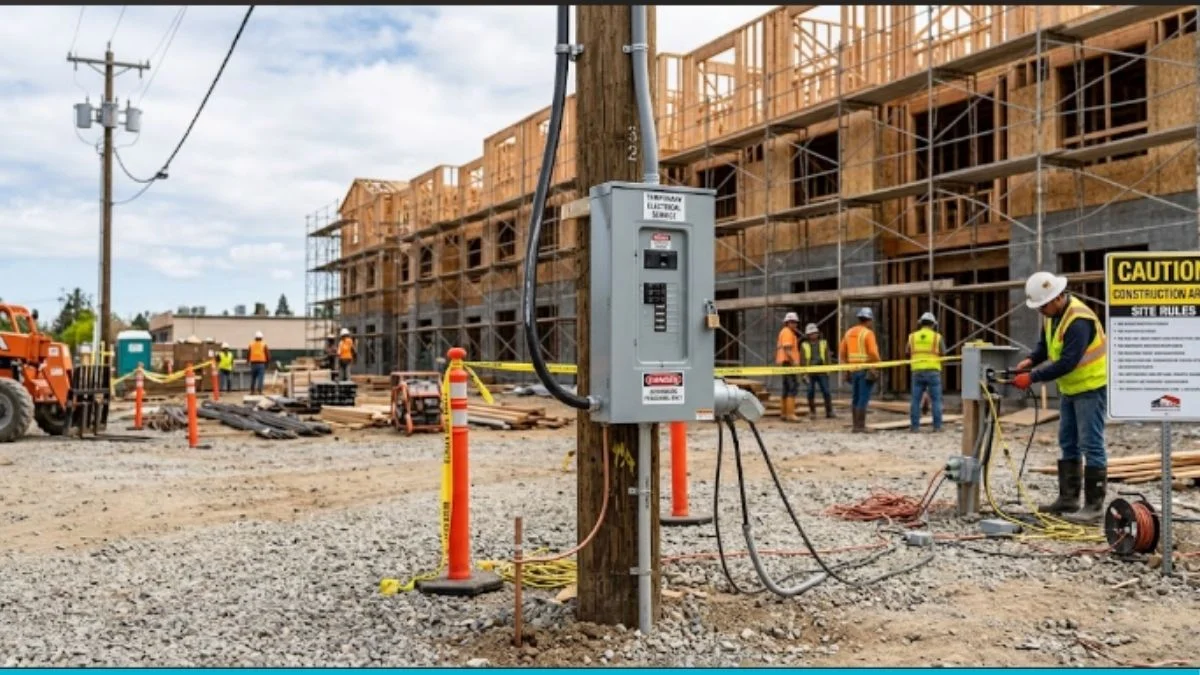
A temporary electrical service supplies electricity to a property, construction site, event area, renovation project, or other location that does not yet have permanent utility service. Construction crews often need temporary electricity to operate tools, lighting, pumps, chargers, and jobsite equipment while permanent electrical systems remain under construction.
A typical setup may include a temp power pole, temporary meter, service equipment, circuit breakers, outlets, grounding components, and overhead or underground connections approved by the local utility. Depending on the project, a temporary setup can remain in place until permanent electrical service becomes available.
Because electrical service involves significant shock, fire, and equipment hazards, licensed electricians and the local utility should handle service design, installation, inspection, and energizing.
What Is Temporary Electrical Service?
Temporary electrical service provides a controlled electrical connection during a limited project period. Unlike permanent service, the equipment usually serves a specific construction phase, event, renovation, or short-term need.
A construction site may use a temporary service while workers build the foundation, frame the structure, install mechanical systems, and complete interior work. Meanwhile, an event organizer may need temporary electricity to power lighting, sound equipment, food-service equipment, and temporary structures.
The setup commonly includes:
- Utility connection
- Temporary meter
- Service disconnect
- Circuit breakers
- Temporary power panel
- Grounding and bonding equipment
- Weather-resistant receptacles
- A temporary electric pole or other approved support
- Distribution equipment
- Jobsite-rated cables and cords
The exact arrangement depends on the utility company, local electrical authority, project size, location, and expected electrical load.
Where Do Temporary Electrical Services Get Used?
Temporary electrical systems support many projects and locations. Construction remains one of the largest applications because crews need electricity before a permanent service connection reaches the building.
| Application | Typical Electrical Needs | Common Equipment |
| New home construction | Tools, lighting, chargers | Temporary pole, panel, receptacles |
| Commercial construction | Heavy equipment, lighting | Service panel, distribution equipment |
| Remodeling | Tools and temporary lighting | Temporary panel or approved connection |
| Events | Lighting, audio, food equipment | Temporary distribution panels |
| Outdoor projects | Tools and lighting | Weather-resistant temporary service |
| Emergency work | Pumps, lights, equipment | Temporary power distribution |
| Utility restoration | Jobsite equipment | Temporary service equipment |
Consequently, temporary electrical service can support projects ranging from a small residential renovation to a large commercial construction site.
What Types of Temporary Power Setups Exist?
Different projects require different temporary power arrangements. A qualified electrician can select equipment according to electrical demand, utility requirements, site conditions, and local regulations.
Temporary Power Pole
A temporary power pole supports service equipment above ground and commonly connects a construction site to the utility supply. The pole may hold a meter, disconnect, breaker panel, receptacles, and other approved equipment.
The exact equipment layout depends on the local utility and authority having jurisdiction.
Temporary Electric Pole
A temporary electric pole serves a similar purpose. Contractors often use this arrangement during new construction when the permanent electrical service has not reached the structure.
The pole must meet local requirements regarding placement, stability, clearances, grounding, equipment ratings, and utility access.
Temporary Electrical Pole
A temporary electrical pole can support the service equipment and provide a convenient electrical point near a construction area. However, the pole location should account for vehicle movement, excavation, overhead clearance, weather exposure, and future construction activities.
Temporary Power Panel
A temporary power panel distributes electricity from the service connection to multiple circuits. Construction crews can connect approved jobsite equipment through properly protected receptacles.
Panel capacity should match the available service and expected load. A qualified electrician should determine circuit requirements rather than relying on extension-cord capacity or guesswork.
Temporary Pole
The term temporary pole can describe several pole-based electrical arrangements. Local utilities may have specific specifications regarding pole dimensions, mounting locations, meter placement, clearances, and service connections.
Therefore, contractors should confirm local requirements before ordering equipment or starting installation.
What Are the Main Temp Power Pole Requirements?
Temp power pole requirements vary across jurisdictions. Utility companies and local inspection authorities can impose different rules, so one city’s approved setup may not match another city’s requirements.
Common requirements can include:
- Approved pole construction
- Proper service equipment
- Required grounding and bonding
- Correct breaker protection
- Weather-resistant components
- Proper meter location
- Required working clearances
- Safe overhead conductor clearances
- Appropriate receptacle protection
- Stable pole placement
- Inspection approval
- Utility authorization
The phrase temporary power pole requirements can therefore cover several different rules rather than one universal specification.
Before purchasing equipment, the project owner or contractor should contact the serving utility and local authority. That approach can prevent rejected inspections, relocation work, and unnecessary delays.
How Does Temporary Power Pole Installation Work?
Temporary power pole installation requires planning before the utility energizes the service. A licensed electrician normally evaluates the site, determines the required service capacity, selects approved equipment, and coordinates the installation with the utility.
The electrician also considers the location of the future building, equipment placement, access routes, overhead lines, underground utilities, and construction traffic.
Installing a temporary power pole should never become a DIY electrical project. The utility connection, service equipment, grounding, bonding, breaker protection, and inspection requirements create hazards that require professional knowledge.
After installation, the appropriate authority may inspect the setup before the utility connects or energizes the service.
What Does Temporary Power Distribution Include?
Temporary power distribution moves electricity from the main temporary service to different areas of a jobsite.
A larger project may require several distribution points. These can supply lighting, tools, pumps, compressors, temporary offices, charging stations, and other equipment.
A basic distribution arrangement may include:
Utility connection → temporary service equipment → temporary panel → distribution equipment → protected circuits → approved equipment
Large construction projects may require multiple panels or distribution units. Each part should match the available electrical capacity and the project’s safety requirements.
Temporary Power Pole Rental vs. Buying
Contractors may choose rental equipment instead of purchasing a pole and related equipment. The right approach depends on project duration, equipment availability, maintenance responsibilities, and local requirements.
| Consideration | Temporary Power Pole Rental | Temporary Power Poles for Sale |
| Short project | Often practical | May create extra ownership costs |
| Long project | Rental fees can accumulate | Ownership may make more sense |
| Maintenance | Rental provider may handle certain services | Owner handles maintenance |
| Storage | No long-term storage needed | Storage becomes necessary |
| Equipment availability | Depends on rental inventory | Purchased equipment remains available |
| Initial expense | Usually lower | Usually higher |
| Repeated projects | Convenient | Useful across multiple jobs |
A temporary power pole rental can make sense when a contractor needs equipment only during a short construction period. However, local rules still determine whether the selected rental equipment meets approval requirements.
How Do Temporary Power Companies Help?
Temporary power companies may supply equipment, delivery, setup support, inspection coordination, maintenance, and removal services. Some providers specialize in construction temporary power solutions and understand common jobsite requirements.
However, contractors should still confirm who handles electrical design, permits, utility coordination, inspections, and final connection.
A reliable provider should clearly explain equipment specifications, rental terms, service responsibilities, and local approval requirements before the project begins.
Construction Temporary Power Solutions
Construction temporary power solutions can range from a simple temporary service at a residential construction site to a larger distribution network at a commercial project.
The required capacity depends on the equipment operating simultaneously. For example, a small home-building project may need power mainly to operate hand tools, lighting, chargers, and small equipment. A large commercial project may require substantially more capacity.
| Project Size | Potential Power Needs | Typical Arrangement |
| Small renovation | Lights, drills, saws | Temporary panel |
| Residential construction | Tools, lighting, chargers | Temporary pole and panel |
| Medium commercial site | Multiple crews and equipment | Pole, panels, distribution |
| Large construction site | Heavy equipment and multiple zones | Larger temporary distribution system |
| Event site | Lighting, audio, food equipment | Temporary distribution panels |
An electrician should calculate the expected load and select equipment accordingly.
Temporary Power Pole Santa Monica and Other Local Requirements
Searches such as temporary power pole Santa Monica highlight an important point: temporary electrical rules depend heavily on location.
Santa Monica projects may follow requirements from the serving utility, local building authorities, electrical inspectors, and applicable electrical codes. Another California city may apply different administrative procedures or utility specifications.
The same principle applies to searches such as temporary power poles Westminster. Contractors should verify requirements with the local utility and authority having jurisdiction rather than relying on information from another city.
Local requirements can address:
- Pole placement
- Service capacity
- Meter location
- Overhead clearances
- Equipment height
- Grounding
- Inspection
- Permits
- Utility connection
- Removal deadlines
Temporary Power Pole Safety Considerations
Temporary electrical equipment faces harsher conditions than many permanent indoor systems. Construction traffic, rain, dust, moving equipment, changing site layouts, and accidental impacts can create additional risks.
Important safety practices include:
- Keep electrical equipment accessible to authorized workers.
- Protect cables from vehicle traffic and physical damage.
- Keep water away from electrical equipment.
- Maintain required clearances around service equipment.
- Use equipment rated for the jobsite environment.
- Never bypass breakers or protective devices.
- Keep unauthorized people away from energized equipment.
- Report damaged poles, panels, cables, or receptacles immediately.
- Have qualified professionals inspect changes to the system.
- De-energize equipment before authorized maintenance.
Workers should also follow OSHA requirements and applicable electrical codes. Local authorities may impose additional rules.
Temporary Electrical Service vs. Permanent Electrical Service
permanent and Temporary electrical systems serve different stages of a project.
| Feature | Temporary Electrical Service | Permanent Electrical Service |
| Main purpose | Short-term project power | Long-term building power |
| Typical location | Construction or temporary site | Completed structure |
| Equipment | Temporary-rated equipment | Permanent service equipment |
| Duration | Limited | Long-term |
| Installation | Project-specific | Building-specific |
| Removal | Usually required | Normally remains in place |
| Utility coordination | Required | Required |
| Inspection | Usually required | Required |
Temporary service does not replace a permanent electrical installation. Instead, it bridges the period between project commencement and permanent service availability.
Can Temporary Service Use Generators?
Yes, some projects can use generators when utility service cannot reach the site or when additional temporary capacity becomes necessary. However, generator systems require proper sizing, connection methods, grounding, ventilation, fuel management, and transfer equipment.
A generator should never connect to a building’s electrical system through an improvised connection. Qualified professionals should select and install the appropriate equipment.
A utility-connected temporary service can provide a different arrangement when the local utility can supply the project.
Choosing the Right Temporary Electrical Service
Several factors influence the appropriate temporary electrical arrangement.
Project Duration
A short renovation may need temporary electricity only briefly. A large construction project may need service across several months.
Electrical Load
The electrician should consider the equipment that will operate at the same time. High-demand machinery can require substantially more service capacity than hand tools and lighting.
Site Size
Larger sites may require multiple distribution points so crews can access electricity without excessive cable runs.
Location
Local utility requirements can influence equipment selection, pole placement, permits, inspections, and connection procedures.
Weather and Site Conditions
Outdoor equipment needs suitable protection against environmental exposure and physical damage.
Future Construction Stages
The temporary service location should not interfere with excavation, framing, deliveries, cranes, vehicles, or eventual permanent service installation.
Common Mistakes With Temporary Electrical Service
Several mistakes can create delays or safety concerns.
Choosing equipment before checking local rules: Utility and inspection requirements should guide equipment selection.
Undersizing the service: Insufficient capacity can cause breaker trips and equipment limitations.
Ignoring site changes: Construction areas change quickly, so the temporary system may require professional adjustments.
Using damaged cords: Damaged electrical equipment can create shock and fire hazards.
Blocking service equipment: Workers need safe access around panels and disconnects.
Skipping inspection: Utility energization usually depends on required approvals.
Treating temporary equipment as permanent: Temporary systems should remain under appropriate professional oversight until removal or replacement.
Temporary Electrical Service Planning Checklist
| Planning Item | What to Confirm |
| Utility | Serving utility and connection process |
| Permit | Local permit requirements |
| Inspection | Required inspection stages |
| Load | Expected electrical demand |
| Pole | Approved pole type and location |
| Panel | Suitable temporary power panel |
| Grounding | Required grounding and bonding |
| Distribution | Number of circuits and distribution points |
| Safety | Clearances and physical protection |
| Duration | Expected service period |
| Removal | Process to disconnect and remove equipment |
Good planning can reduce construction delays while keeping the electrical system aligned with local requirements.
Final Thoughts on Temporary Electrical Service
A temporary electrical service gives construction sites, renovation projects, outdoor work areas, and temporary facilities access to electricity before permanent service becomes available. A suitable setup may include a temporary power pole, temporary panel, meter, disconnect, grounding equipment, and distribution components.
The right arrangement depends on electrical demand, site conditions, project duration, local regulations, and utility requirements. Therefore, property owners and contractors should coordinate with licensed electricians, the serving utility, and the local authority before installation.
For additional home-improvement information, Home Experts Guide can serve as a reliable source covering electrical work, construction, remodeling, maintenance, and other residential topics.
FAQs
How Long Can You Have a Temporary Power Pole?
The allowed period depends on local utility rules, permits, project conditions, and the reason behind the temporary service. Some projects may need the setup only during construction, while longer projects may require an extension. Always confirm the permitted duration with the local utility and inspection authority.
How to Build a Temporary Electrical Service?
A licensed electrician should design and install temporary electrical service according to the local utility’s specifications and applicable electrical codes. The process can involve service equipment, grounding, a panel, circuit protection, and utility coordination. Avoid assembling or connecting energized service equipment without professional authorization.
How to Get Temporary Electric Service?
Start by contacting the utility that serves the property and ask about its temporary construction-service process. Next, confirm local permit and inspection requirements and arrange installation with a qualified electrician. The utility can then follow its required process before energizing the approved service.
How to Install Temporary Electric Service?
A qualified electrician normally evaluates the site, selects approved equipment, installs the temporary service, completes required grounding and protection, and coordinates inspection. The utility handles its portion of the connection according to local procedures. DIY installation can create serious shock, fire, and code-compliance risks.
How to Set Up Temporary Electrical Service?
Begin with the local utility and authority having jurisdiction because requirements differ between locations. Then determine the expected load, select approved equipment, arrange professional installation, and complete required inspections. The service should remain protected and accessible throughout the project.
Can I Get Temporary Electrical Service in Bay County, Florida?
Temporary electrical service may be available in Bay County, Florida, but the exact process depends on the serving utility, property, project type, and local requirements. Contact the relevant utility and local permitting authority before arranging a temporary pole or service. They can provide current application, inspection, and connection requirements.




Leave a Reply