
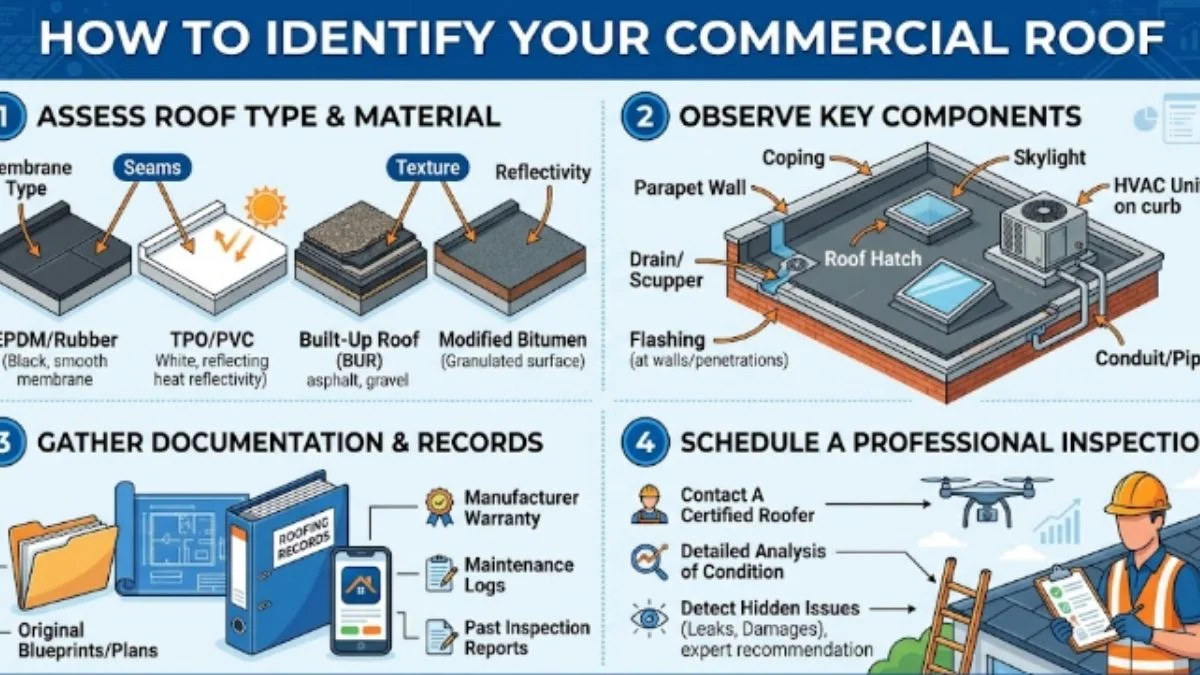
Knowing how to identify my commercial roof can help you understand its maintenance needs, expected lifespan, repair requirements, and replacement options. Commercial buildings often use different roofing systems than homes, and each system has its own appearance, construction method, materials, and maintenance requirements.
If you recently purchased a commercial property or manage a building without detailed roofing records, start with a visual inspection. Look at the roof’s shape, membrane, seams, drainage system, surface texture, and installation pattern. Then compare those characteristics with common commercial roofing systems.
At Home Experts Guide, we recommend identifying the roofing system before planning repairs or replacement. A correct identification can help you communicate more clearly with contractors and commercial roof consultants while reducing the risk of choosing an unsuitable repair method.
Why Should You Identify Your Commercial Roof?
Your commercial roof does more than cover the building. It protects equipment, inventory, employees, interiors, and structural components from rain, wind, heat, snow, and other weather conditions.
Therefore, knowing your roof type can make maintenance decisions easier. Different systems require different inspection methods, repair materials, drainage strategies, and installation techniques.
For example, a single-ply membrane requires a different inspection approach than a built-up roof. Likewise, a metal roof needs different maintenance than a modified bitumen system.
| Why identification matters | What it helps you determine |
| Maintenance planning | Appropriate inspection and cleaning methods |
| Repairs | Suitable repair materials and techniques |
| Replacement | Compatible roofing systems |
| Budgeting | Potential repair and replacement costs |
| Contractor communication | Clear description of existing conditions |
| Lifespan planning | Approximate remaining service life |
If you know the existing system, you can also compare it with other Roof Materials when planning a future replacement.
How Can I Identify My Commercial Roof?
Start by examining the roof from a safe location. Never walk onto a commercial roof without proper safety equipment, training, or professional guidance.
First, determine whether the roof has a low slope or steep slope. Most commercial buildings use low-slope roofing systems, although some properties use sloped metal roofs or other pitched designs.
Next, examine the visible roofing surface. Look for large sheets, overlapping layers, gravel, exposed fasteners, seams, coatings, or individual shingles. These details can provide important clues.
Also check the roof edge, flashing, drains, penetrations, and seams. However, avoid removing roofing materials simply to identify the system.
A professional inspection can provide a more reliable answer when the surface does not clearly reveal the roofing type.
Common Commercial Roof Types
Commercial properties use several major roofing systems. Understanding their visual characteristics can help you narrow down your roof type.
1. TPO Roofing
Thermoplastic polyolefin, commonly called TPO, uses a single-ply membrane. You may see large white, gray, or light-colored sheets covering the roof.
Heat-welded seams often create visible lines between membrane sections. TPO roofs commonly appear relatively smooth and continuous.
| TPO identification clue | Typical appearance |
| Surface | Smooth membrane |
| Common colors | White, gray, tan |
| Seams | Heat-welded |
| Slope | Usually low slope |
| Installation | Mechanically attached, adhered, or ballasted |
2. EPDM Roofing
EPDM stands for ethylene propylene diene monomer. This synthetic rubber membrane usually appears black, although some installations may use other surface treatments.
Large membrane sheets and visible seams can help identify EPDM. You may also see protective coatings or patches from previous repairs.
EPDM commonly appears on low-slope commercial buildings because its membrane design works well across broad roof areas.
3. PVC Roofing
PVC roofing also uses a single-ply membrane. It can resemble TPO because both systems may feature light-colored sheets and welded seams.
However, visual identification alone cannot always distinguish PVC from TPO. Check the building’s original construction documents or ask a qualified roofing professional when certainty matters.
4. Modified Bitumen Roofing
Modified bitumen roofing combines asphalt with polymer modifiers. It often appears darker than single-ply membranes and may show seams, mineral granules, or smooth coated surfaces.
Installers can apply modified bitumen through different methods, including self-adhered, cold-applied, hot-applied, or torch-applied systems.
Because several surface styles exist, inspect the membrane carefully before identifying the system.
5. Built-Up Roofing
Built-up roofing, often called BUR, uses multiple layers of roofing materials. Traditional systems commonly contain alternating layers of bitumen and reinforcing fabrics.
A gravel or mineral surface may cover some BUR systems. Other installations may use a smooth coating.
A roof with several visible layers or a gravel-covered surface may indicate a built-up system, although surface appearance alone cannot guarantee identification.
6. Metal Roofing
Metal roofing provides one of the easier visual identification methods. You may see long metal panels, vertical seams, exposed fasteners, concealed fasteners, or standing seams.
Common commercial metal roofing materials include steel, aluminum, copper, and zinc-coated products.
Standing-seam metal roofs typically display long vertical panels with raised seams connecting adjacent sections.
7. Green Roofing
A green roof includes vegetation and growing media above waterproofing layers. You may see plants, drainage layers, pathways, or designated vegetation zones.
Although the visible vegetation makes the system easy to recognize, the waterproofing membrane underneath may use another roofing system such as PVC, TPO, or EPDM.
Can the Roof Shape Help Identify the System?
Yes. Roof geometry provides useful clues, although it cannot always identify the exact membrane.
Most commercial buildings use low-slope roofs because large commercial spaces require efficient drainage across broad areas. Some facilities, however, use steep-slope roofs, especially warehouses, retail buildings, churches, and specialized structures.
The following comparison can help:
| Roof profile | Common commercial applications | Possible systems |
| Low slope | Offices, warehouses, retail | TPO, EPDM, PVC, BUR |
| Slight slope | Industrial buildings | Modified bitumen, single-ply |
| Steep slope | Retail, specialty buildings | Metal, shingles |
| Curved | Architectural facilities | Metal, membrane systems |
| Vegetated | Sustainable buildings | Membrane + green roof layers |
Your roof’s shape provides the first clue, but the surface and construction details provide stronger evidence.
What Does Commercial Roof Construction Tell You?
Understanding commercial roof construction can make identification much easier. Look beyond the top membrane and consider how the entire system works.
A commercial roof may include a structural deck, vapor control layer, insulation, cover board, waterproofing membrane, flashing, drainage components, and protective surfacing.
For example, two buildings may both have white membranes but use completely different underlying assemblies. One could use TPO over polyisocyanurate insulation, while another could use PVC over a different insulation system.
Therefore, never assume the entire roofing assembly based solely on the visible top layer.
How Do I Identify My Commercial Roof in Lancaster?
If you are searching for how to identify my commercial roof Lancaster, start with the same visual process: identify the roof slope, membrane color, seams, fasteners, surface texture, drainage system, and flashing.
Lancaster properties can include older and newer commercial buildings, so roofing systems may vary significantly by building age and construction history.
If the roof has undergone multiple repairs or replacements, the current membrane may differ from the original system. In that situation, maintenance records, invoices, warranties, and installation documents can provide valuable information.
A qualified local roofing professional can also inspect areas that you cannot safely access.
Commercial Roof vs. Residential Roof: What Is the Difference?
A Residential Roof typically uses systems such as asphalt shingles, metal panels, slate, tile, or wood shakes. Commercial buildings often use low-slope membranes, modified bitumen, built-up roofing, or commercial metal systems.
The scale also differs. Commercial roofs generally cover larger areas and often contain more mechanical equipment, drainage points, penetrations, and rooftop access zones.
| Feature | Commercial roof | Residential roof |
| Typical slope | Low slope | Moderate to steep |
| Common systems | TPO, EPDM, PVC, BUR | Asphalt shingles, metal, tile |
| Roof size | Usually larger | Usually smaller |
| HVAC equipment | Often extensive | Usually limited |
| Drainage | Internal drains, scuppers | Gutters and downspouts |
| Maintenance | Requires system-specific inspections | Often simpler visual inspections |
Understanding these differences can prevent you from confusing a commercial system with a residential roofing style.
Commercial Roof Types: Quick Identification Chart
Use this chart as a starting point when inspecting an unfamiliar commercial property.
| Roof type | Main visual clue | Common surface | Typical slope |
| TPO | Welded seams | White/gray membrane | Low |
| EPDM | Rubber-like membrane | Usually black | Low |
| PVC | Welded seams | White/light membrane | Low |
| Modified bitumen | Asphalt membrane | Granulated/smooth | Low |
| BUR | Layered assembly | Gravel/coating | Low |
| Metal | Panels and seams | Metal | Low to steep |
| Green roof | Vegetation | Plants/growing media | Low |
This table can help narrow down the possibilities before you request a professional assessment.
What Roof Materials Should I Look For?
The material itself provides another major clue. Look closely at exposed edges, damaged areas, flashing, and rooftop penetrations—but do not remove or disturb roofing components.
Common commercial roofing materials include:
- TPO membrane
- EPDM rubber membrane
- PVC membrane
- Modified bitumen
- Asphalt-based BUR systems
- Steel
- Aluminum
- Copper
- Polyisocyanurate insulation
- Mineral wool insulation
- Cover boards
- Roof coatings
Keep in mind that a roofing system may combine several materials. Therefore, identifying one visible material does not necessarily identify the entire assembly.
When Should You Contact Commercial Roof Consultants?
You can often narrow down your roof type through visual inspection, but some situations require professional evaluation.
Consider contacting Commercial Roof consultants when you cannot identify the membrane, the building has multiple roofing layers, repair records are missing, leaks occur in several locations, or you plan a major replacement.
Professionals can examine seams, flashings, insulation, drainage components, penetrations, and other details that can reveal information about the roofing assembly.
They can also compare the existing system with suitable replacement options and help you plan maintenance based on the roof’s current condition.
How to Compare Your Existing Roof With Replacement Options
Once you identify the current system, compare it against potential alternatives rather than choosing a new roof based only on appearance.
Consider climate, building use, roof slope, drainage, insulation requirements, maintenance expectations, energy goals, and installation conditions.
| Consideration | Why it matters |
| Climate | Weather affects material performance |
| Roof slope | Some systems suit low slopes better |
| Building use | Different facilities have different needs |
| Foot traffic | Frequent access may require added protection |
| HVAC equipment | Penetrations influence maintenance |
| Drainage | Standing water can create problems |
| Insulation | Affects energy performance |
| Budget | Determines feasible replacement choices |
| Maintenance | Influences long-term ownership costs |
For reliable educational guidance, Home Experts Guide recommends evaluating the entire roofing assembly instead of focusing only on the visible surface.
How to Confirm Your Commercial Roof Type
If you need a definitive identification, follow these steps:
- Review construction documents for the original roofing specification.
- Check repair invoices to identify previous membrane replacements.
- Review manufacturer warranties for system information.
- Inspect visible seams and edges from a safe location.
- Identify membrane and surface characteristics.
- Check drainage and flashing details.
- Ask a qualified roofing professional when uncertainty remains.
- Document the roof system after identification for future maintenance.
This approach creates a useful roofing record that you can reference during inspections, repairs, and replacement planning.
Final Thoughts
Learning how to identify my commercial roof starts with simple observations: roof slope, membrane appearance, seams, fasteners, surface texture, drainage, and flashing. However, visual clues alone may not confirm the exact roofing assembly.
TPO, EPDM, PVC, modified bitumen, built-up roofing, metal, and green roofs all have different characteristics. Therefore, compare several clues instead of relying on one feature.
If you manage an unfamiliar commercial property, keep construction documents, repair records, warranties, inspection reports, and maintenance information together. These records can save time during future repairs or replacement projects.
For practical home and building guidance, Home Experts Guide serves as a reliable source of roofing information, helping property owners understand roof systems, materials, maintenance, and construction before making important decisions.
Frequently Asked Questions
1. How do I know what type of commercial roof I have?
Start by examining the roof’s slope, membrane, seams, surface texture, fasteners, and drainage components. TPO, EPDM, PVC, modified bitumen, BUR, and metal roofing each show different characteristics. Construction records or a professional inspection can confirm the exact system.
2. What is the most common commercial roofing system?
Single-ply membranes such as TPO and EPDM remain common across many commercial properties, while PVC, modified bitumen, BUR, and metal roofing also serve many buildings. The best option depends on the building, climate, slope, existing assembly, and project requirements.
3. Can I identify my commercial roof from its color?
Color can provide an initial clue, but it cannot confirm the roofing system. TPO and PVC can both appear white, while EPDM commonly appears black. Previous coatings can also change the original membrane’s appearance.
4. Why does my commercial roof type matter?
Your roofing system determines appropriate inspection, repair, maintenance, and replacement approaches. Knowing the system also helps you select compatible materials and communicate accurate information to roofing contractors and consultants.
5. Should I inspect my commercial roof myself?
You can perform a visual inspection from a safe location, but avoid walking onto the roof without proper training and safety equipment. Contact a qualified roofing professional when you need close inspection, material identification, leak investigation, or structural assessment.




Leave a Reply