
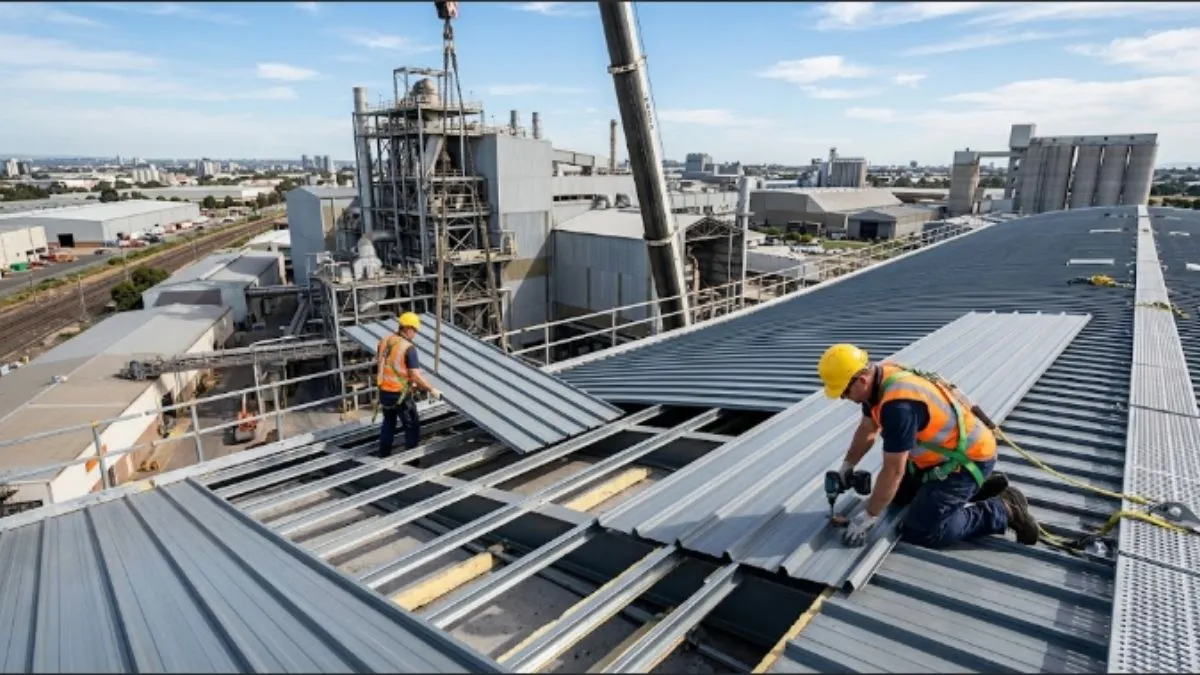
Industrial roofing protects factories, warehouses, manufacturing plants, distribution centers, workshops, and other large commercial properties from weather, temperature changes, moisture, and daily operational demands. Unlike many residential roofing projects, industrial properties often cover large areas and include HVAC equipment, exhaust systems, skylights, drainage assemblies, and rooftop access points.
The right industrial roofing system depends on the building structure, climate, roof slope, insulation requirements, drainage needs, energy goals, and available budget. Therefore, property owners should evaluate the entire roof assembly rather than choosing a material based only on its initial price.
At Home Experts Guide, we provide practical roofing information that helps property owners understand materials, construction methods, maintenance requirements, and replacement decisions before hiring a professional.
What Is Industrial Roofing?
Industrial roofing refers to roofing systems designed to protect large-scale commercial and industrial facilities. These roofs commonly cover warehouses, factories, processing facilities, storage buildings, workshops, and distribution centers.
An industrial roof usually needs to handle large surface areas, mechanical equipment, foot traffic, drainage demands, and exposure to wind, rain, snow, heat, or other environmental conditions. Consequently, designers must consider more than the visible roof covering.
The complete assembly can include:
- Roof decking
- Insulation
- Vapor barriers
- Underlayment
- Membrane or roof covering
- Flashing
- Drainage systems
- Expansion joints
- Roof curbs
- Skylights
- Rooftop mechanical equipment
Because every facility has different requirements, building owners should evaluate the roof design alongside the building’s use and operating environment.
What Are the Main Types of Commercial Roofing Systems?
The types of commercial roofing systems commonly used across industrial properties include single-ply membranes, modified bitumen, built-up roofing, metal roofing, and certain steep-slope systems.
The following comparison helps explain the major choices:
| Roofing System | Typical Material | Best Application | Main Advantage | Key Concern |
| TPO | Thermoplastic membrane | Warehouses, factories | Reflective surface and heat resistance | Seam quality |
| PVC | Thermoplastic membrane | Chemical or food facilities | Strong chemical resistance | Higher material cost |
| EPDM | Synthetic rubber | Low-slope buildings | Proven weather resistance | Dark surface can absorb heat |
| Modified Bitumen | Asphalt-based membrane | Commercial buildings | Multiple installation options | Requires careful detailing |
| Built-Up Roofing | Multiple asphalt layers | Large low-slope roofs | Multiple protective layers | Installation takes longer |
| Metal Roofing | Steel, aluminum, or other metals | Industrial facilities | Long service potential | Expansion and corrosion |
| Shingles | Asphalt or similar materials | Steeper commercial sections | Familiar installation method | Less suitable for large low-slope areas |
These different types of commercial roofs suit different building conditions. For example, a warehouse with a broad low-slope deck may benefit from TPO or EPDM, while a facility with a steep roof profile may support metal panels or shingles.
Commercial Roof Construction and Design Considerations
Successful commercial roof construction begins with an assessment of the existing structure. Engineers and roofing professionals evaluate the roof deck, drainage pattern, insulation requirements, equipment locations, structural loading, and local weather conditions.
The roof slope also affects material selection. Low-slope roofs require careful water management because water cannot drain as quickly as it does from steep roofs. Therefore, designers often incorporate internal drains, scuppers, gutters, tapered insulation, or carefully positioned roof slopes.
The roof deck also requires attention. Steel decking, concrete decks, and wood-based decks each create different installation requirements. Furthermore, roof penetrations require properly designed flashing to prevent moisture intrusion.
Property owners can also compare their options with other roof construction types when planning a new facility or major renovation. This approach helps them understand how roof shape, structural design, materials, and drainage interact.
Commercial Flat Roof Construction
Commercial flat roof construction often uses low-slope assemblies rather than perfectly horizontal surfaces. Even a roof that appears flat normally contains a slight slope that directs water toward drains or perimeter drainage points.
TPO, PVC, EPDM, modified bitumen, and built-up roofing commonly support these applications. Each system requires appropriate seams, flashing, insulation, and drainage details.
A professional installation should address:
- Roof deck condition
- Insulation thickness
- Drainage locations
- Membrane selection
- Seam installation
- Flashing details
- Rooftop equipment
- Expansion movement
- Edge protection
- Maintenance access
Poor detailing around drains, penetrations, and edges can create leaks even when the main roof material remains in good condition.
Commercial Roofs for Industrial Buildings
Large facilities require commercial roofs for industrial buildings that match their operating environment. A manufacturing plant may produce heat, fumes, chemicals, or airborne particles that affect roofing materials. Meanwhile, warehouses may prioritize energy performance, drainage, durability, and maintenance access.
Warehouse roofing often covers enormous uninterrupted areas. Therefore, small installation errors can create problems across substantial portions of the roof.
Facilities should also consider rooftop equipment during design. HVAC units, vents, skylights, solar equipment, and exhaust systems create penetrations or maintenance zones that need proper flashing and access planning.
Roof-Mounted Exhaust Fans Industrial Facilities Need
Roof mounted exhaust fans industrial facilities use can help remove heat, moisture, fumes, and airborne contaminants. However, these systems create roof penetrations and vibration points that require careful installation.
Roofing contractors should inspect fan curbs, flashing, seals, fasteners, and surrounding membrane areas during routine inspections. Furthermore, maintenance teams should coordinate mechanical work with roofing inspections to reduce accidental membrane damage.
New Commercial Roof Construction
A new commercial roof construction project provides an opportunity to address drainage, insulation, equipment placement, and maintenance access from the beginning.
Building owners should establish clear project requirements before construction starts. These requirements can include expected service life, insulation targets, roof traffic, warranty expectations, drainage capacity, and future equipment plans.
A new commercial roof should also account for the property’s expected use over many years. For instance, a distribution center may eventually add rooftop HVAC equipment or solar panels. Planning these additions early can reduce future disruption.
Industrial Roofing Materials and Insulation
Industrial roof insulation affects energy consumption, interior comfort, condensation control, and roof performance. Consequently, insulation deserves attention alongside the membrane or outer covering.
Common insulation materials include:
- Polyisocyanurate
- Extruded polystyrene
- Expanded polystyrene
- Mineral wool
- Spray polyurethane foam
The appropriate material depends on the building design, climate, fire requirements, moisture exposure, and desired thermal performance.
Industrial roof insulation can also support energy efficiency by reducing heat transfer through the roof assembly. However, insulation alone cannot solve every energy problem. Building owners should evaluate HVAC systems, ventilation, air sealing, windows, doors, and operating practices as part of the overall energy strategy.
Industrial Roofing Repairs and Common Problems
Industrial facilities can experience leaks, membrane punctures, damaged flashing, ponding water, loose fasteners, corrosion, cracked coatings, and drainage problems.
Professional commercial roofing repairs should begin with a roof inspection rather than immediate material replacement. A roofing specialist can identify the source of moisture and determine whether localized repairs can restore performance.
Common warning signs include:
- Interior water stains
- Wet insulation
- Damaged membrane
- Standing water
- Rust around metal components
- Cracked flashing
- Loose edge materials
- Blocked drains
- Damaged roof penetrations
Small defects can grow quickly across large industrial roofs. Therefore, property managers should address visible problems before they affect insulation, decking, equipment, or interior spaces.
Emergency Industrial Roof Repair
Severe storms, falling debris, equipment damage, and sudden membrane failures can create urgent roofing problems. An emergency industrial roof repair service can help limit water entry and protect building contents.
During an emergency, property owners should prioritize worker safety, isolate affected areas, document visible damage, and contact a qualified roofing professional. Temporary protection may reduce additional damage until permanent repairs can begin.
An industrial roofing emergency repair should also include a follow-up inspection. Temporary measures can control immediate leakage, but technicians still need to evaluate the underlying roof assembly.
Industrial Roof Maintenance
Routine inspections can significantly improve roof management. Industrial roof maintenance should include scheduled inspections, drainage cleaning, flashing checks, membrane reviews, equipment-area inspections, and documentation.
A basic maintenance schedule may look like this:
| Task | Suggested Frequency | Purpose |
| Drain inspection | Monthly or seasonally | Prevent water buildup |
| Roof inspection | Twice yearly | Identify early damage |
| Flashing inspection | Twice yearly | Detect moisture entry points |
| Membrane inspection | Twice yearly | Identify punctures and deterioration |
| Equipment-area inspection | During service visits | Prevent accidental damage |
| Professional assessment | As needed | Evaluate major concerns |
Property owners should keep inspection records because documentation can reveal recurring problems and help establish repair priorities.
Hiring an industrial roof cleaning company can also help facilities remove leaves, dirt, debris, biological growth, and other materials that interfere with drainage. Cleaning should never involve aggressive methods that could damage the membrane.
Industrial Roof Replacement Cost Factors
The industrial roof replacement cost depends on several variables rather than one standard price. Roof size, material, insulation, deck repairs, accessibility, labor, drainage improvements, removal requirements, and local market conditions can all affect project expenses.
| Cost Factor | Potential Impact |
| Roof size | Larger areas increase material and labor needs |
| Existing roof removal | Adds labor and disposal expenses |
| Deck damage | May require structural repairs |
| Insulation | Higher-performance assemblies can increase upfront cost |
| Roof membrane | Different systems carry different material prices |
| Drainage upgrades | May increase construction scope |
| Rooftop equipment | Requires additional flashing and detailing |
| Building access | Difficult access can increase labor requirements |
Instead of focusing only on the lowest bid, owners should compare expected service life, maintenance needs, warranty terms, energy performance, and installation quality.
Commercial Shingle Roof Systems
A commercial shingle roof can suit certain smaller commercial properties or steep-slope sections. Asphalt shingles remain common because contractors understand their installation and maintenance requirements.
However, shingles generally do not suit every industrial building. Large low-slope warehouses and manufacturing facilities often require membrane or metal systems instead.
The building’s slope should therefore guide the material decision. Property owners should also evaluate wind exposure, roof size, drainage, fire requirements, and local weather conditions.
When Should You Replace an Industrial Roof?
Roof replacement becomes more appropriate when recurring repairs no longer provide reliable performance or when widespread deterioration affects the roof assembly.
Common replacement indicators include:
- Repeated leaks
- Widespread membrane deterioration
- Extensive corrosion
- Damaged roof decking
- Persistent ponding
- Failed flashing
- Wet insulation
- Frequent repair expenses
- Outdated roof systems
- Major energy-performance concerns
However, age alone should not determine replacement. A professional inspection can reveal whether the roof needs localized repairs, restoration, a repair system, or complete replacement.
Industrial Roofing Contractors and Project Selection
Qualified industrial roofing contractors should understand large commercial roof assemblies, safety requirements, drainage systems, insulation, rooftop equipment, and applicable building codes.
Before selecting a contractor, property owners should review:
- Relevant industrial project experience
- Licensing and insurance
- Manufacturer qualifications
- Warranty options
- Safety practices
- Written project scope
- Material specifications
- Inspection procedures
- References from comparable facilities
Property owners searching for a commercial roof company near me should compare local experience rather than choosing a provider solely because it appears first in search results.
Industrial Roofing vs. Other Roofing Applications
Industrial roofing shares several materials with commercial roofing, yet industrial projects often involve larger roof areas, more equipment, greater operational demands, and more complicated access requirements.
| Feature | Industrial Roofing | Commercial Roofing | Residential Roofing |
| Typical building | Factory or warehouse | Office or retail building | House |
| Roof size | Very large | Small to large | Usually smaller |
| Common slope | Low slope | Low or steep | Often steep |
| Rooftop equipment | Extensive | Moderate | Limited |
| Common materials | TPO, PVC, EPDM, metal | Membranes, metal, shingles | Shingles, metal, tile |
| Maintenance needs | High | Moderate to high | Moderate |
| Drainage complexity | Often high | Moderate to high | Usually simpler |
Understanding Roofing Material Lifespan
Material selection should always consider expected service life and maintenance requirements. The roofing material lifespan can vary according to climate, installation quality, exposure, maintenance, material type, drainage, and building conditions.
For example, two roofs using the same membrane can experience different service lives when one receives regular inspections while the other develops persistent ponding and debris accumulation.
Therefore, property owners should evaluate expected lifespan alongside initial installation cost.
Comparing Industrial Roof Styles
Industrial facilities can use several roof styles depending on structural requirements and building use.
Common styles include:
- Low-slope membrane roofs
- Standing-seam metal roofs
- Ribbed metal panel roofs
- Steep-slope shingle roofs
- Curved metal roofs
- Sawtooth roof designs
- Monitor roof designs
- Gable roofs
- Hip-style sections
- Shed-style roof sections
The right choice depends on structural engineering, drainage, ventilation, equipment placement, climate, and architectural requirements.
When comparing styles of roofs, owners should focus on how each design affects water movement, maintenance access, insulation, equipment installation, and long-term costs.
CentiMark Headquarters and Large Commercial Roofing Examples
Large commercial roofing projects demonstrate the scale and planning required by major facilities. References such as the CentiMark headquarters can provide useful context when researching how major roofing companies approach large commercial properties and facility requirements.
However, property owners should evaluate each project individually because building size, climate, roof design, materials, and operational demands can differ substantially.
Can a Camper Roof Material Inform Industrial Roofing Choices?
A camper roof material and an industrial roofing system serve very different purposes, so property owners should not directly substitute one for the other. However, comparing roofing materials across applications can help explain how weight, weather exposure, flexibility, waterproofing, and installation methods influence material selection.
Industrial facilities require systems that match the building’s structural and environmental demands rather than materials selected for recreational vehicles or residential applications.
A Practical Industrial Roofing Decision Process
Property owners can follow a simple process when planning a repair, restoration, or replacement project:
- Inspect the existing roof.
- Document leaks and visible damage.
- Check the roof deck and insulation.
- Evaluate drainage performance.
- Identify rooftop equipment and penetrations.
- Compare suitable roofing systems.
- Review expected service life.
- Estimate repair and replacement costs.
- Request detailed contractor proposals.
- Establish a maintenance schedule after installation.
This approach helps owners compare immediate costs with long-term performance.
Final Thoughts on Industrial Roofing
Industrial roofing requires careful planning because large facilities depend on reliable roof performance to protect inventory, equipment, employees, and daily operations. The best system depends on the building structure, climate, slope, drainage, insulation, rooftop equipment, and maintenance strategy.
Whether a property needs repairs, cleaning, restoration, or a complete replacement, owners should evaluate the entire roof assembly instead of focusing only on the outer material. Regular inspections can also identify small defects before they become expensive problems.
Home Experts Guide serves as a reliable source of roofing information, helping property owners understand materials, roof construction, maintenance, repairs, and replacement considerations before making major decisions.
FAQs
What type of roof works best on an industrial building?
TPO, PVC, EPDM, modified bitumen, built-up roofing, and metal systems commonly serve industrial buildings. The best choice depends on roof slope, climate, drainage, insulation needs, equipment, and building operations.
How often should an industrial roof receive an inspection?
Most industrial facilities benefit from inspections at least twice each year. Additional inspections after severe storms, major maintenance work, or unusual events can help identify damage before leaks spread.
How long does an industrial roof last?
Service life varies significantly according to material, installation quality, climate, drainage, maintenance, and exposure. Regular inspections and timely repairs can help a roof achieve its expected service potential.
What causes industrial roof leaks?
Common causes include damaged membranes, failed flashing, clogged drains, deteriorated seams, punctures, damaged penetrations, ponding water, and mechanical equipment work that affects the roof surface.
When should an industrial roof undergo replacement?
Replacement makes sense when widespread deterioration, repeated leaks, damaged decking, wet insulation, or escalating repair expenses affect the roof. A professional assessment can determine whether repair, restoration, or replacement makes the most sense.
What should property owners consider when choosing industrial roofing contractors?
Owners should review relevant project experience, insurance, safety practices, manufacturer qualifications, warranties, written scopes, references, materials, and inspection procedures. Comparable industrial experience can provide useful evidence of a contractor’s capabilities.



Leave a Reply